

Modern metals production depends on large amounts of electrical energy. In many electro-intensive processes, however, supplying power is only the first requirement. Electrical energy must also be converted and regulated according to the specific needs of the metallurgical process.
Aluminum smelting, copper electrorefining and the electrowinning of metals such as copper, zinc and nickel require controlled direct current. In these applications, the rectifier is an integral part of the production system, influencing process stability, operational continuity, energy consumption and long-term plant performance.
Why metals production requires high-power DC
Industrial electrical systems generally supply alternating current, while electrochemical metal production processes require direct current to enable metal extraction, refining or deposition.
High-power rectifiers convert AC power into the DC output required by the process. Depending on the application, they may need to deliver very high current at relatively low voltage or combine high current and voltage to reach the required power level.
Conversion alone is not enough. The rectifier must also regulate its output as operating conditions evolve. Temperature, electrolyte composition, electrode condition and production load can change during operation. Maintaining the required electrical parameters under these conditions supports consistent process performance.
Different processes, different rectifier requirements
There is no single rectifier configuration suitable for every metals application.
Primary aluminum production uses electrolysis to reduce alumina dissolved in molten cryolite to aluminium. Smelter potlines operate continuously and require exceptionally high DC currents, making efficiency, stable regulation and long-term rectifier system availability essential.
Electrowinning uses direct current to recover metals such as copper, zinc and nickel from electrolyte solutions. Current density, voltage range and load profile vary according to the metal and process design.
In copper electrorefining, controlled DC current transfers copper from impure anodes and deposits it onto cathodes, producing high-purity copper for electrical and industrial applications. Stable current regulation and accurate DC measurement support consistent refining conditions and reliable operation.
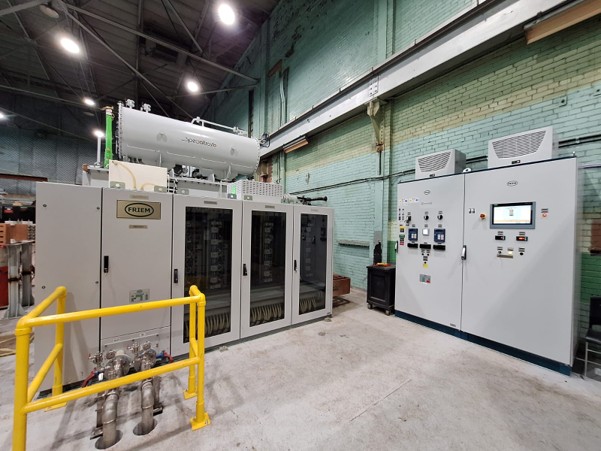
FRIEM high-current rectifier system installed at a copper refinery in Canada
Performance, reliability and efficiency
Rated power is only one factor in determining whether a rectifier system is suitable for a metallurgical process. Current and voltage regulation, DC ripple, efficiency, cooling, monitoring and maintainability must also be considered.
Reliability is particularly important because many metals plants operate continuously and under demanding environmental conditions. Rectifier system availability depends on the coordinated design of the power section, cooling system, semiconductors, controls, protections and measurement equipment.
Efficiency has a direct impact on operating costs. Even a small difference in transformer and rectifier losses can become significant when a high-power rectifier system operates continuously throughout the year. Its performance should therefore be evaluated under actual operating conditions, considering the expected load profile, auxiliary consumption and cooling requirements.
These factors cannot be assessed independently. The rectifier system must be developed around the interaction between the electrical supply, the equipment and the metallurgical process.
Download the case study
Explore how the expertise of FRIEM can boost efficiency, reliability and lifecycle support. This case study features an application case from a copper refining plant in Canada.